At Green Healthcare International, our goal is education before treatment decisions.
Our role is advocate and coordinator. We provide independent education, research insights, patient advocacy and treatment navigation. Green Healthcare International does not conduct research, does not provide medical treatment itself and does not claim that any regenerative therapy cures a condition. If you decide to explore care, we help you ask the right questions, organize your records and compare qualified, appropriately authorized providers.
This Education Center is designed to help patients and families understand regenerative medicine, separate established medicine from emerging research, recognize potential risks and limitations, and know what questions to ask before considering care—whether in Costa Rica, Colombia, Mexico or elsewhere.
We do not believe patients should make important healthcare decisions based solely on advertising, testimonials or promises. Patients should understand the science, the regulatory status of a proposed therapy, the qualifications of the medical professionals involved and the alternatives available to them.
Advanced regenerative medicine · Beyond conventional IV delivery
Why the delivery method matters.
Regenerative medicine research is exploring whether the method of cell delivery may influence how investigational therapies interact with specific tissues and organs. Research programs, including those at Mayo Clinic, are studying approaches that go beyond traditional intravenous infusion.
Standard research approachSystemic IV administrationInvestigational approachesIntrathecal, neurologically targeted & organ-directed delivery
Standard IV infusionCells enter the bloodstream and distribute throughout the body.
vs
Targeted delivery (investigational)Cells are introduced closer to a specific organ or tissue.
Closer is not automatically better. Placing cells nearer to an affected area may change where they first go — it does not by itself mean better clinical results. Illustration only.
01Nervous system
Parkinson’s disease: research is moving beyond IV delivery
Standard: IV, systemicInvestigational: intrathecalInvestigational: intraputaminal transplant
A crucial distinction: direct brain transplantation studies typically use dopaminergic progenitor cells, not the same MSC products used in many IV or intrathecal protocols. Two approaches are being studied:
Intraputaminal transplantationDopamine progenitor cells are surgically placed into the putamen, the movement-related area that loses dopamine input from the substantia nigra. Early clinical trials.Intrathecal administrationCells enter the cerebrospinal fluid around the spinal cord. Reaching the fluid does not guarantee cells reach or repair the brain regions affected by Parkinson’s.
What the research shows so far
A 2025 phase 1/2a study of 12 patients reported encouraging early safety findings and improvements in certain motor assessments after direct putamen transplantation. Another clinical research program, STEM-PD, is investigating direct intraputaminal transplantation of stem-cell-derived dopaminergic cells. These findings require larger controlled trials.
No approach has been proven to reverse Parkinson’s disease. Brain transplantation requires specialized neurosurgery and cell products, and specialist neurological oversight is essential.
Kidney disease: Mayo Clinic is investigating targeted delivery
Standard: IV, systemicInvestigational: IV + renal-artery infusion
Mayo Clinic’s FDA-authorized Regenerative Nephrology Compassionate Use program describes two strategies: IV infusion alone, and combined IV plus direct intra-arterial infusion into each kidney. An earlier Mayo phase 1 study delivered patient-derived MSCs into the artery of one kidney in diabetic kidney disease.
IV infusion aloneSingle-day treatment. Cells enter an arm vein and circulate through the body; many infused MSCs first lodge in the lungs.IV + intra-arterial to each kidneyTwo-day treatment. In addition to IV, a catheter guided from the groin delivers cells into the artery of each kidney. Investigational.
Mayo states that MSCs are investigational and not FDA approved to treat kidney disease. Kidney-directed delivery is not established as superior to IV; vascular, embolic and contrast-related risks must be considered.
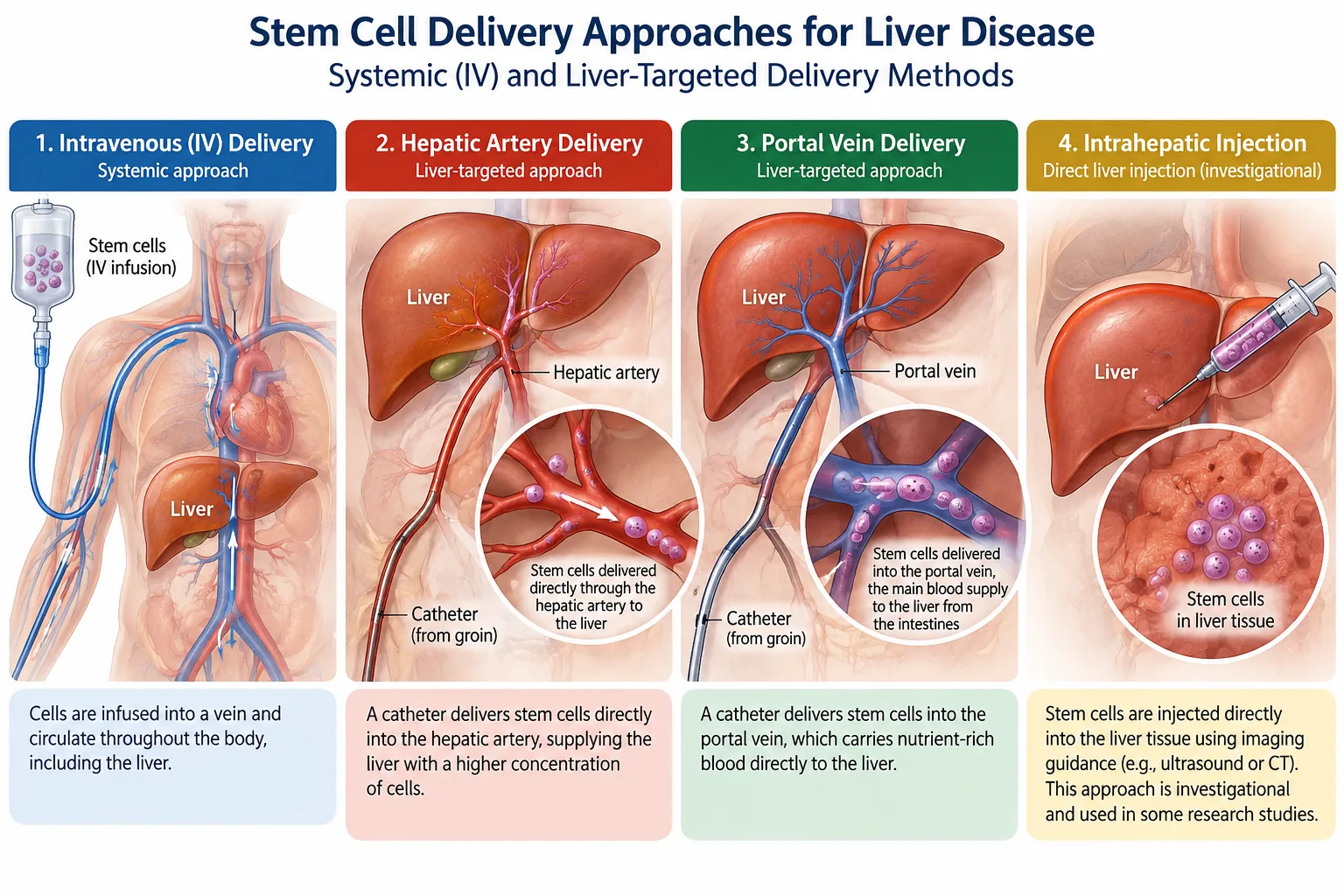
Four delivery approaches studied for liver disease: systemic IV, hepatic artery, portal vein and direct intrahepatic injection. Liver-targeted routes are investigational. Tap to enlarge.
Mayo Clinic announced a collaboration with HepaTx to investigate cells derived from MSCs that are engineered toward liver-cell-like functions. This differs from simply infusing ordinary MSCs through an IV or liver artery: the objective is to explore whether specialized cells can help replace or restore damaged liver tissue. Mayo describes the technology as experimental and being developed for early clinical investigation.
Other researchers have investigated hepatic artery and portal vein delivery. The Mayo collaboration does not compare routes, so it should not be read as evidence that those routes are superior.
Improved liver function or survival has not been consistently demonstrated for organ-directed delivery. Arterial and portal access carry significant procedural risks.
IV systemic Standard research approachBroad exposure to circulating cells and their signaling effectsMany infused MSCs initially accumulate in the lungs; clinical effectiveness remains unproven for these diseases
Intrathecal InvestigationalExposure to cerebrospinal fluid and central nervous system compartmentsLimited evidence of meaningful Parkinson’s disease benefit
Intraputaminal InvestigationalDirect placement of dopamine progenitor cells in a movement-related brain regionEarly clinical trials; specialized neurosurgery and cell products required
Renal artery InvestigationalDirect exposure of the kidney to MSCsEarly Mayo studies; not established as superior to IV
Hepatic artery / portal vein InvestigationalOrgan-directed cell deliveryInvestigational; vascular and procedural risks must be considered
These approaches remain investigational. No delivery method should be assumed to provide superior outcomes without appropriate clinical evidence. Our approach is to help patients understand the science, treatment differences, clinical limitations and physician recommendations before making an informed decision.
We can never guarantee results. But we can ask the question that matters: would you like to explore whether a targeted, research-driven protocol could improve your chances compared with a standard baseline approach? Ask us for details — we’ll share the published studies and outcome data for your condition so you and your physician can weigh the evidence together.
The science matters more than the marketing
Not all regenerative medicine protocols are created equal.
The question isn’t simply how many cells you’re receiving. It’s who developed the protocol, how the cells are verified, where they’re delivered, and what clinical evidence supports that approach.
For Parkinson’s, liver disease and kidney disease, researchers are exploring targeted delivery methods beyond conventional IV infusion. But closer delivery does not guarantee better results — these techniques remain investigational, and their benefits and risks must be evaluated individually.
What patients should investigate before choosing a clinic
Educational information only. Targeted delivery routes are investigational; they are not established as superior to IV infusion, and outcomes cannot be guaranteed. Green Healthcare International coordinates and advocates — it does not provide treatment. Discuss risks and alternatives with a qualified specialist.
Considering care in Costa Rica, Colombia or Mexico?
The same questions matter wherever care takes place: who will treat you, what you will receive, what evidence supports it, how it is regulated locally, and who will coordinate follow-up.
A treatment offered abroad is not automatically FDA-approved. Local authorization and U.S. authorization are separate questions. Ask for the relevant documentation before making a decision.
A private, by-application program with a dedicated expert patient advocate, hand-selected physicians and discreet coordination from the first conversation to long-term follow-up.